Showing posts with label psychology. Show all posts

Wednesday, December 14, 2011

Boys are good at math; girls are good at English

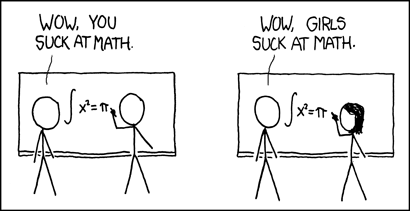
"How it Works" from xkcd.
The American Mathematics Society has just published a paper entitled "Debunking Myths About Gender and Mathematics Performance." What's interesting to me about the paper isn't that it tells us that girls have no inherent disadvantages relative to boys in math classes; what's interesting is that it's able to show correlation between math performance by gender and larger societal forces. The more equal the society at large, the smaller the gap in performance between boys and girls. That correlation compellingly demonstrates that the observed differences in performance are due entirely to perceptions of gender, not anything biologically inherent to gender. 

So when we see girls underrepresented in a high level class in a given subject, what we have to blame is the messages we send to those girls that says "this subject isn't for you" or, worse, "you're at a disadvantage here." Those messages must be erased from our institutions if we want to have students who achieve great things. We need to destroy the institutional structures that hold students back in this fashion; these include stereotypes, teachers' attitudes, and some aspects of the tracking system. And even when we cannot outright eliminate the destructive structure, we need to encourage our young women to see those negative pressures for what they are and to excel despite them.

You'd think that in a progressive school environment filled with varied examples of strong intellectuals, you would no longer overhear statements that tie a student's performance to his or her gender. And it's true that I can't remember the last time I've overheard anybody speculate that a girl wouldn't be as good as a boy in a math or science environment, despite the fact that the stereotype persists in the world at large.

However, I have heard, on a number of occasions, chatter about the difficulties boys have in excelling in English classes. Various aspects of male biology are cited in these conversations: later puberty, difficulty sitting still, inability to understand complex emotions, etc. All of these tidbits sound plausible, and the person making them typically has good intentions, but the statements are just as sexist, unfair, and destructive as a condescending comment that a girl has difficulty with complex mathematics because she has a girl's brain. And no matter how positively they're intended, they become a self-perpetuating drag on student performance.

Stereotype threat is real, and it's one of the greatest barriers to student progress, particularly to the progress of struggling students. Whether the threat comes from a student's gender, race, or level assignment, it pervades every aspect of the learning process. It pushes a student to disengage from the daily work that builds mastery. It turns a failure into evidence of the stereotype and a success into a fluke. It demotivates, disheartens, and delegitimizes our students and their work.

Individual students struggle with maturity, abstract thinking, and complex systems, but generalizing those difficulties to a gender—or any group—is worse than useless. It's wrong; it limits our students; and we need to stop doing it. We need to be prepared for our individual students to have difficulties, but we should not expect them to have a difficulty because of their gender, and we should not excuse that difficulty as a result of gender.

And once we have erased it from our own assumptions as teachers, we need to go on the attack to shine the light of day on institutional and societal practices that create and confirm these stereotypes. Is leveling students so beneficial that we're OK with creating groups of students that we institutionally identify as less capable? Even knowing that by doing so, we're creating a downward pressure on their learning? Do we offer enough extra services to our "B-level" and "C-level" students to counteract our labeling of them as such?

I'm not sure that we do, and I wonder that if we changed some of our teaching models (large classes, teacher-focused learning, etc.), we might be able to reduce some of the need to track students and thus reduce the negative pressure.

Wednesday, October 12, 2011

The IQ Fallacy

Too often, we think of intelligence as a fixed quantity, as if we have a certain amount of a magical substance in our heads, and that amount can not be essentially changed. It's a dangerous, damaging, depressing fallacy, and in my experience, it's one of the greatest obstacles to student learning.

David Shenk nicely debunks this fallacy in a 2009 article for The Atlantic. He argues, rather convincingly, that while our genes may theoretically influence our intelligence, our development is a much larger agent in our problem solving ability. IQ is a measurement of a particular set of skills, and those skills can be improved.

Let's not also forget that the IQ test is intentionally narrow in its measurement. It quantifies a particular kind of problem solving, and it does it well, but it makes no attempt to measure intelligence types that are at least as important.

So the next time your student, your colleague, your family member says he's "not smart" or is "bad at that," it might help to remind him that his disposition toward himself or to the subject is much more predictive of his success than the jar of quicksilver ability he believes has been doled out to him by his genes or his creator.

It's not his fault, of course. Western society (and probably others) is absolutely replete with institutional and cultural building blocks that encourage us to think of our abilities as fixed and immovable. Impressive people have "genius;" struggling students are "weak." We separate kids by abilities early in their lives, and we might even refer to some of them as "gifted," as if the others didn't receive the gene as their first birthday present.

This mindset both encourages mediocrity and devalues achievement. A student who demonstrates brilliance in a paper has brought a lifetime of dispositions, opportunities, choices, and yes, talents. But let us not confuse a knack that allows a student to progress quickly for an irreproducible gift that the student has received through some genetic sorcery.

"But," you say, "I have students who work incredibly hard who don't make as much progress as students who do less work. Is that not proof of the existence of talent, raw intelligence, and a gift?" Maybe, and I don't claim to understand every aspect of the interaction between genes, brains, and choices. There probably are starting lines drawn in some ways in our abilities. But I'm also willing to bet dollars to donuts that your hardworking student also has limiting dispositions in his work and that your lessworking student has advantages that have little to do with raw intelligence.

What we mistake for a static gift is actually a combination for factors, the majority of which we can change, and we can influence. Your student has a measurable IQ, but the question isn't "what's your IQ?" The question is "what are you doing to raise it?"

Wednesday, September 7, 2011

Mixing Up Instructional Style

I love finding articles that challenge common wisdom, like this recent NPR piece that upends the notion of "visual" and "auditory" learners. I've always thought that tailoring your instruction to an auditory learner, even if he actually exists, doesn't necessarily do him a great service. As long as our central mission is to teach kids how to learn autonomously, catering to their strengths is only one piece of the puzzle. It's just as important to help them expand the ways they learn. An auditory learner should be working on learning better with visuals.

In these first weeks of school, I have kids setting goals for themselves and their year. One girl said that she wasn't very visual and had trouble imagining the details of setting in certain books. She felt it was impeding her ability to enjoy those books and to understand them as deeply as she wanted to. She didn't demand books that better suited her strengths. She recognized that if she wanted to access an important text that didn't play to her reading style, she'd need to adapt. 

So it's great to hear some brain scientists sending us a message that underscores the importance of a varied teaching style. Whether or not the purported "auditory" and "visual" learners really exist, good teaching is going to constantly mix up the ways kids are asked to engage with material. They need to read, to draw, to visualize, to move, to argue, to listen, and to do the million other things a great intellectual does to grapple with a meaningful set of concepts.

And I love that this piece challenges our bias towards the status quo. The human brain always runs under assumptions—without which we couldn't function effectively—but some of the most deeply embedded common wisdom is probably false, so we need to be questioning those obvious things that we take for granted, at least once in a while.

I'm challenging myself this week to mix it up. I tend to rely heavily on writing-as-thinking and discussion as a sort of default mode for approaching a text, but I'm going to challenge myself to get my kids moving, drawing, flow-charting, or carving wax sculptures.

Thursday, February 10, 2011

Nihil Novi

"Nihil novi sub sole..." (Ecclesiastes 1:9, Biblia Sacra Vulgata).

There is nothing new under the sun (Ecclesiastes 1:9, NIV).

There is nothing new under the sun but there are lots of old things we don't know (commonly attributed to Ambrose Bierce).

Recently, we had an English department meeting in which the concept of "21st century" skills was kicked around a bit. It got me to thinking: what are the things we want to teach that are actually bona fide skills unique to the 21st century? Very few of them are going to turn out to be 100% brand new. In fact, the more I thought about it, the more I realized that none of them are truly new. However, many of them need to be freshly prioritized or even rediscovered, and a few are simply so rare in the general population and so hard to teach that they need to be attempted over and over with the hope that they begin to stick.

So what things need to be freshly invigorated in today's high school curriculum?

Citizenship: Voting and advocacy are hardly inventions of the 21st century (pretty sure the Greeks had lobbyists), and neither is Yellow Journalism (the 1890s saw the first iteration of the kind of shoddy journalism we still see today). However, we do live in a highly partisan era and an era in which we're saturated with information that does not organize itself with the most accurate facts at the top. So we need to focus a huge amount of attention on teaching kids how to sort information, how to assess its credibility and bias, and how to draw strong conclusions from evidence instead of warping evidence to support their preconceptions. That last one is incredibly difficult, since the human mind naturally creates cognitive biases, and learning to identify your own is, by definition, always a challenge.

Nuance: One kind of cognitive bias is the human mind's resistance to nuance. It wants answers, black and white clarity, good guys and bad guys. In many situations, it's quicker and easier to think that way, but life's most difficult questions are difficult precisely because they're not manichaean. They require us to search our world and our souls for answers, and we cannot ignore our responsibility to teach kids how to approach these questions openly and honestly.

Education in Metaphor: I borrow heavily from Robert Frost's "Education By Poetry" for this concept, but I think his 20th century sentiment—rather 19th century, actually—still speaks loudly for the 21st:
They are having night schools now, you know, for college graduates. Why? Because they have not been educated enough to find their way around in contemporary literature. They don’t know what they may safely like in the libraries and galleries. They don’t know how to judge an editorial when they see one. They don’t know how to judge a political campaign. They don’t know when they are being fooled by a metaphor, an analogy, a parable. And metaphor is, of course, what we are talking about. Education by poetry is education by metaphor.
Though I'm working off a version later published as an essay, Frost first gave this talk exactly eighty years ago in February 1931. No matter how many times I find predictive wisdom in the words of an old master, I still feel that little thrill like a static shock.  We have to teach kids to interpret metaphor—and rightly under the umbrella of metaphor are all sorts of rhetorical and expressive forms of language—so they can "find their way around" in contemporary literature and life. If you cannot use your skills in logic and metaphor to spot a false analogy when you see one, you will find it very difficult not to be driven about like a sheep. The shepherds have developed some very sophisticated tools.

The last 21st century skill that's frying my brain on this fine morning is the ability to articulate and defend your ideas. If we're going to teach kids to develop ethical, honest ideas from their analysis of complex evidence, we had better darn well teach them how to stand up for those ideas and communicate them clearly. That means teaching them to write clearly and teaching them how to contribute in groups of all sizes and compositions. They need to be able to work with a partner towards a common goal, to play the role a small group needs from them rather than insisting on doing things their own way, to stand in front of a group with or without visuals and props and inspire respect.

So there may be nothing new under the sole, but there's definitely always something new in the soul, eh?